

D&O Message
A newsletter on developments relating to the personal responsibility of members of Boards of Directors and Executive Committees (Directors’ & Officers’ Liability, D&O).
2025 marks a turning point in global events, and the world finds itself in a state of radical uncertainty that has established itself as the new normal. At the same time, the pace of technological innovation, such as artificial intelligence and advancing automation, is greatly increasing and the effects of the climate crisis are becoming ever more apparent. These tensions are putting huge pressure on managers, who can find themselves being held accountable for failing to have adequate risk management in place and/or misjudging these complex issues.
LIABILITY UNDER COMPANY LAW – CASE STUDIES FROM THE PRESS
LERCH
Lerch AG, a construction company based in Winterthur, Switzerland, is closing its doors after 165 years. Despite the boom in construction, its profitability was undermined by the shortage of qualified staff, rising construction costs and tough competition over prices. Thanks to a debt moratorium, the company was able to avert bankruptcy and find solutions with the help of an administrator. Three other companies in the region are taking on most of the company’s 130 employees as well as its ongoing projects. This case highlights the importance of D&O insurance. In times of crisis, it can protect managers against personal liability in connection with errors of judgment or omissions. If decision-makers don’t have the relevant cover, their personal assets are at risk in the event of insolvency.
GOOGLE, APPLE AND UBER
Google, Apple and Uber faced data protection problems that led to substantial settlements and financial penalties. Apple paid USD 95 million as a settlement, and a financial penalty of over EUR 290 million was imposed on Uber (although the company has appealed against it). Google was the subject of a class action lawsuit, and the group was forced to pay USD 350 million in compensation as part of settlement negotiations following a cyber incident. Its decision-making bodies were accused of not reporting relevant information adequately and not disclosing it, resulting in market fluctuations. Given the violations of data protection law, companies are likely to face an increased number of civil or administrative lawsuits in the future.
RAIFFEISEN
The Swiss Federal Supreme Court has overridden the ruling of Zurich’s Cantonal Court of Appeal in the criminal proceedings against Pierin Vincenz. The indictment meets the legal criteria because the complexity of the accusations requires a detailed description. The right to translation was also not violated because the defendant was able to understand the accusations and put forward a defense. The Court of Appeal now has to hear the appeal instead of referring the case back to the Office of the Public Prosecutor for the revision of the indictment. If D&O insurance is in place, the limitation of damages under the contract would have to be reactivated. Innocence is presumed until it has been refuted in the final instance.
CURRENT AND FUTURE CHANGES IN LEGISLATION
EU SUPPLY CHAIN DIRECTIVE
The EU’s new Corporate Sustainability Due Diligence Directive (CSDDD) takes precedence over Germany’s Supply Chain Act (Lieferkettensorgfaltspflichtengesetz, LkSG) and also applies to non-European companies operating within the EU. This means that the Swiss suppliers of German companies, for example, may also be affected. The CSDDD requires companies along the entire supply chain to adhere to human rights and environmental standards, and introduces liability under civil law. They are also obliged to analyze risks, establish duties of care and issue regular reports. The directive is being implemented in stages over a period of up to five years, making early compliance measures essential. The new corporate responsibility initiative 2.0 is aimed at adopting the EU’s strict regulations. At the same time, the EU’s latest proposal (Omnibus package) aims to soften the requirements of the CSDDD.
ARTIFICIAL INTELLIGENCE
The Swiss Federal Council is planning to ratify the Council of Europe’s Convention on Artificial Intelligence and amend Swiss law accordingly. The regulation is to be targeted and sector-specific, taking essential issues relating to basic rights such as data protection into account. Voluntary sector-related solutions are also planned in addition to the legal measures. The aim is to build up Switzerland as a center of innovation, preserve basic rights and the freedom of the market, and promote trust in AI. The regulation focuses on government agencies, while companies should benefit from clear framework conditions. By the end of 2026, the Swiss Federal Departments of Justice and Police, the Environment, Transport, Energy and Communications, and Foreign Affairs will draw up a bill for consultation that covers the topics of transparency, data protection, nondiscrimination and supervision. At the same time, a plan for nonbinding measures, harmonized with international standards, is being developed. Stakeholders from industry and the civil service are being involved in the process.
ANTITRUST FINES
Düsseldorf District Court ruled that antitrust fines imposed on companies cannot be passed on to those companies’ directors by means of recourse, and the Higher Regional Court of Düsseldorf confirmed this in its judgment on appeal. The possibility of recourse in such a case would run counter to the purpose of the sanction under antitrust law, since fines are both specific and punitive. However, board members may be liable for further damages internally – for example for potential claims for damages from third parties pursuant to Sec. 33a of the German Competition Act (Gesetz gegen Wettbewerbsbeschränkungen, GWB) – if they culpably (i.e. intentionally or through negligence) violate their obligation to comply with the law. The question of whether fines can be passed on to companies is still unresolved. The question of liability will ultimately have to be decided by the Court of Justice of the European Union (CJEU), following a request for a ruling from the German Federal Supreme Court (Bundesgerichtshof, BGH). If fines can be passed on in this way, this could entail significant consequences for the D&O insurance market.
GOOD TO KNOW - LATE NOTIFICATION
The obligation to report is specified by contract for cases that need to be reported to the insurer in question. The lightest-touch variant of this is an obligation without consequences. The stricter version is an obligation with consequences – in most cases, a right on the part of the insurer to reduce benefits. The strictest of all is the imposition of a condition precedent. This means that if the obligation is not met, the insurance cover does not apply.
If the consequence is not explicitly stipulated, Art. 38 (2) of the Swiss Insurance Contract Act (Versicherungsvertragsgesetz, VVG) applies as ruled by the Swiss Federal Supreme Court (BGer 4A_490/2019 dated May 26, 2020): “In the event of a culpable violation of the obligation to report, the insurer may reduce the amount of compensation insofar as the loss increased as a result of the delayed report.” No reduction is imposed if the policyholder can provide reasonable justification for the delay, or if the insurer is unable to provide evidence that the loss increased. In any case, action should be taken as soon as possible when a loss comes to light.
CURRENT ISSUES
COMPANY INSOLVENCIES
As a Swiss insurance broker, we have been noting with concern the steady increase in the number of company insolvencies. The number of insolvencies in Switzerland reached a high of 11,506 in 2024 (15% more than in the previous year), with the construction, retail, B2B services and hospitality industries particularly badly affected. Against this backdrop, D&O insurance is crucial for protecting decision-makers. We have also seen that the business judgment rule is becoming more of a factor – and rightly so. Pure intuition or insufficient documentation increase the personal liability risk. Decisions should be made on the basis of reliable and verifiable information. Because of this, careful risk analyses and documented decision-making processes are just as essential as having the right D&O insurance in place.
MARKET DEVELOPMENT
BENCHMARK FOR LIMITS OF LIABILITY
Average sums insured by our customers as at May 2025
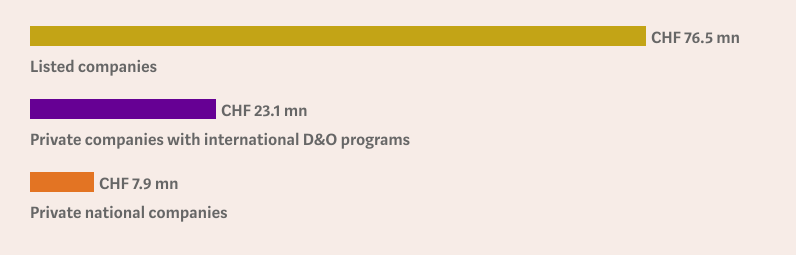
Despite the ongoing geopolitical and economic uncertainties, new technological developments and the influence of the US, which is acting as a catalyst, the Swiss D&O insurance market appears to be subject to its own tensions, and has remained remarkably resilient thus far. It is still dominated by attempts to squeeze out competitors and tough competition over prices, but to a lesser extent than over the last 18 months. This is also reflected in our benchmark data. The insured sums purchased remain stable, which indicates that any surplus capacities haven’t become much more affordable, or that the marginal benefit has been exhausted. Nevertheless, all of the insurers are still chasing ambitious growth targets. This may also be because the Swiss D&O insurance market is special, and remains highly profitable according to our figures. The frequency of claims and the amounts paid out within our customer base have remained constant for several years now.

Are you interested in a collaboration or do you have any questions? Your contact person looks forward to hearing from you.
Sébastien Wyss
Head Business Unit Special Risks
